H.264, H.265, or AV1: Picking the Wrong Codec Is a Budget Killer
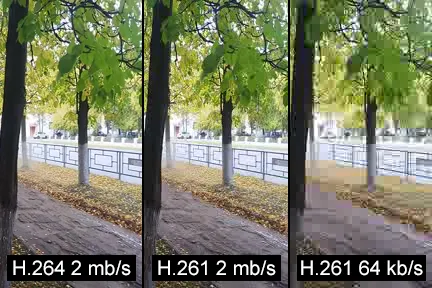
Photo: Emil Dalalyan, CC0, via Wikimedia Commons
Let's be honest — most streaming operations pick H.264 because it's familiar. It's been around since 2003, every device on the planet supports it, and nobody ever got fired for choosing it. But "nobody got fired" is a terrible engineering principle, and in 2025, sticking with H.264 out of habit could mean you're spending significantly more on CDN bills than you need to.
The codec you encode with isn't just a technical detail buried in your settings panel. It directly determines how much data you push, how much your CDN charges you, and whether viewers on slower connections can even watch your content without rebuffering every 30 seconds. That's real money and real audience retention on the line.
The H.264 Reality Check
H.264 (also called AVC) is the workhorse of the streaming industry. It's reliable, universally supported, and deeply understood by every major encoder on the market. For hardware decoding, it's essentially everywhere — smartphones, smart TVs, gaming consoles, laptops, you name it.
But that universal support comes at a cost: efficiency. H.264 typically requires a bitrate of around 4–8 Mbps to deliver a clean 1080p stream at 30fps. For a broadcaster pushing live content to tens of thousands of concurrent viewers, those megabits add up fast. At $0.08 per GB (a rough mid-tier CDN rate), a 2-hour event streamed at 5 Mbps to 10,000 simultaneous viewers costs roughly $7,200 in bandwidth alone. Scale that across a month of regular programming and you're looking at serious overhead.
The codec also has no licensing surprises at the consumption level for most use cases, which has historically been a selling point. But that calculus gets more complicated when you look at the alternatives.
H.265 (HEVC): The Efficiency Promise With a Licensing Asterisk
H.265, or HEVC, delivers roughly 40–50% better compression than H.264 at equivalent visual quality. That same 1080p stream that needed 5 Mbps under H.264 can look just as good at 2.5–3 Mbps under H.265. Run the same bandwidth math and you're potentially cutting that $7,200 event cost nearly in half.
So why isn't everyone using it? Two words: patent licensing.
HEVC is controlled by a fragmented pool of patent holders organized under multiple licensing bodies — HEVC Advance, Via LA, and others. Depending on your distribution model, you may owe royalties on content delivered via HEVC. For large-scale commercial broadcasters, those fees can erode the bandwidth savings faster than you'd expect. For smaller independent creators, the licensing situation is murky enough that many legal teams simply advise against it.
Device support is also uneven in ways that matter. While modern iOS devices, newer Android phones, and most 2018+ smart TVs handle HEVC hardware decoding just fine, older devices — and there are still a lot of them in American households — may fall back to software decoding, which tanks battery life and causes playback issues on lower-end hardware.
Bottom line: HEVC is genuinely powerful, but you need to model your audience's device breakdown before committing to it as your primary delivery codec.
AV1: The Open-Source Dark Horse
AV1 is where things get genuinely exciting, especially if your operation is built for the next three to five years rather than just today.
Developed by the Alliance for Open Media (a coalition that includes Google, Netflix, Amazon, Apple, and others), AV1 is royalty-free and delivers compression efficiency that rivals or beats HEVC — some benchmarks show 30% better efficiency than HEVC and up to 50% better than H.264 at the same quality level. Netflix has been rolling it out for years. YouTube serves AV1 to compatible browsers by default. This isn't experimental technology anymore.
The catch? Encoding is computationally expensive. Real-time AV1 encoding for live streaming has historically required serious hardware investment — we're talking dedicated encoder cards or high-core-count server infrastructure. Software-only AV1 encoding at broadcast scale has been a bottleneck, though that's changing rapidly with GPU-accelerated encoders from NVIDIA (via NVENC) and Intel (via Quick Sync).
For VOD workflows, AV1 is increasingly a no-brainer if your audience skews toward Chrome, Firefox, or newer smart TVs. The encode-once, deliver-many model means you absorb the compute cost upfront and reap bandwidth savings on every subsequent delivery. For live streaming, the calculation is tighter but improving every quarter.
Running the Real ROI Numbers
Here's a simplified framework for thinking through codec ROI for your specific operation:
Step 1 — Know your audience's device profile. Pull your analytics. What percentage of your viewers are on iOS vs. Android? What are the most common browsers? If more than 20% of your viewers are on devices that don't support hardware HEVC or AV1 decoding, factor in the quality degradation risk.
Step 2 — Calculate your current bandwidth spend. Your CDN invoice tells you this. Break it down to cost per GB.
Step 3 — Model the savings. If you're currently delivering at 5 Mbps with H.264 and could deliver equivalent quality at 2.8 Mbps with HEVC or 2.2 Mbps with AV1, calculate the percentage reduction in data transferred and multiply by your current monthly CDN spend.
Step 4 — Factor in licensing and compute costs. HEVC licensing varies; get a quote if you're operating at commercial scale. AV1 encoding hardware or cloud compute costs should be amortized over your expected delivery volume.
For a mid-sized streaming operation pushing 500 TB per month at $0.07/GB, switching from H.264 to AV1 for VOD content could theoretically save $8,750–$12,000 per month in CDN costs alone. That's not a rounding error — that's a full-time hire.
The Practical Playbook
There's no single right answer here, and anyone who tells you otherwise is selling something. The most pragmatic approach for most operations in 2025 looks something like this:
- Use H.264 as your baseline for maximum compatibility, especially for live streams where encoding latency is critical and your audience device profile is unknown.
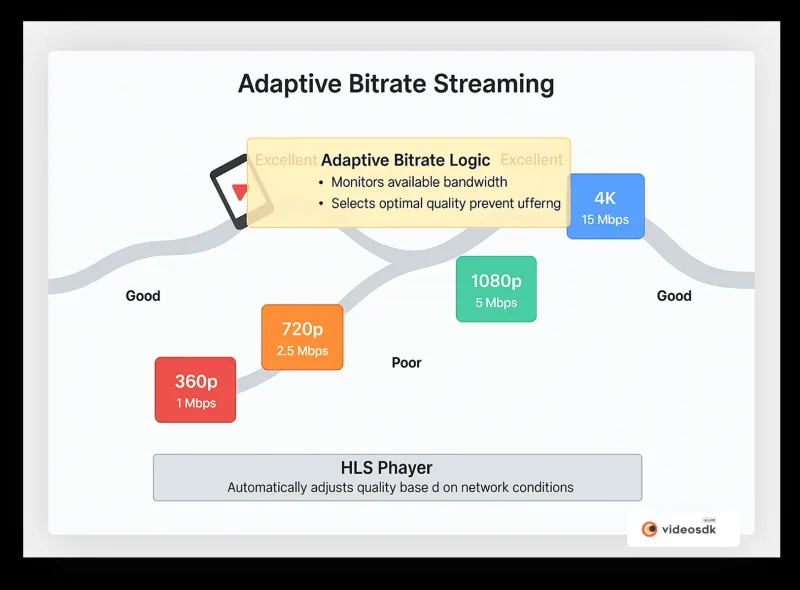
- Add an HEVC rendition for audiences on modern devices where you can confirm hardware decode support — many ABR players will select it automatically when available.
- Invest in AV1 for VOD if your audience skews toward modern browsers and connected TVs. The bandwidth savings compound over time.
- Revisit this decision annually. AV1 hardware encoding support is expanding fast, and the economics shift every time a major device platform adds native support.
The codec wars aren't really a war — they're a spectrum of trade-offs. The operators who win are the ones who run the numbers specific to their operation instead of just inheriting someone else's encoder defaults.